How to Improve Privacy With Modern Glass Solutions
Privacy is changing from a fixed barrier into a controllable building function. Modern glass can protect meeting rooms, bathrooms, clinics, and street-facing offices without creating dark interiors. Switchable glass changes from transparent to opaque when electricity activates its liquid-crystal or polymer-dispersed layer. Frosted films, patterned interlayers, and electrochromic coatings offer additional control.
The U.S. Department of Energy reports that windows can account for approximately 25% to 30% of residential heating and cooling energy use. This makes glass selection a privacy decision and an energy decision. The global smart-glass market is also expanding. Grand View Research estimates that the market reached about USD 5.5 billion in 2023, with continued growth expected through 2030. Figures vary by definition and region, so product claims deserve careful checking.
Dr. Helen Sanders, a building-envelope specialist and former Glass Association of North America technical leader, explains: “The right glazing solution must balance daylight, energy performance, comfort, and privacy.” That balance matters in real spaces. A conference room may need instant opacity during a sensitive discussion, while a clinic may require permanent visual screening near a reception desk. Sensors, wall switches, and building-management controls can automate these changes. Installation quality matters just as much. Poor edge sealing, visible wiring, or delayed switching can weaken user confidence. The technology is impressive, but not perfect. A privacy audit should review sightlines, nighttime reflections, maintenance access, and emergency visibility before specifying the glass. This practical approach shows how to improve privacy with modern glass solutions without sacrificing daylight, comfort, or design clarity.
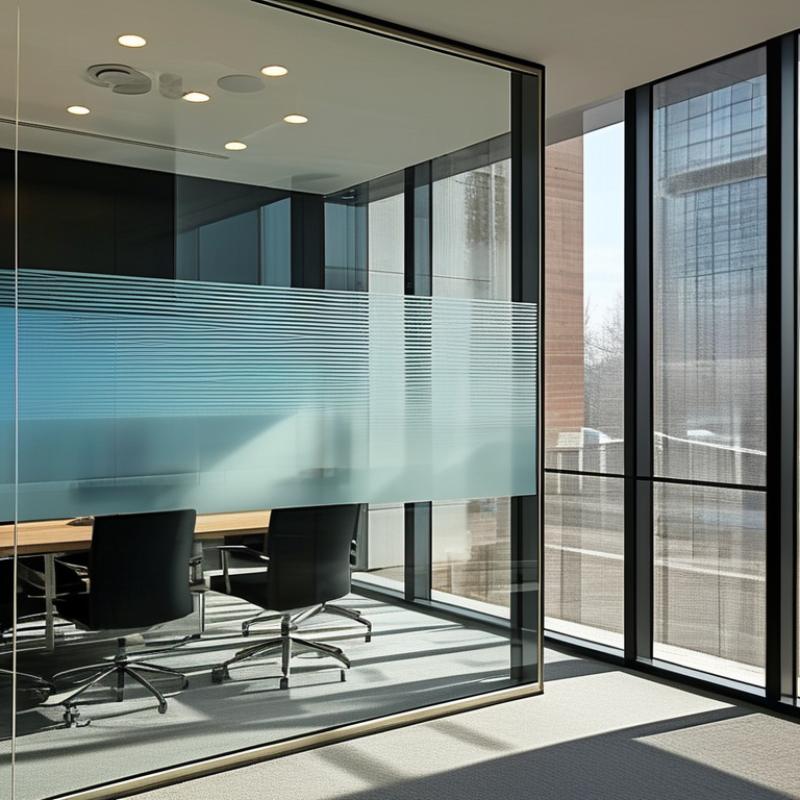
Assess Sightlines and Privacy Zones with NFRC 200 Visible-Transmittance Data
Modern glass can support privacy, but the decision should begin with sightlines rather than appearance. NFRC 200 visible-transmittance data shows how much visible light passes through a glazed product. A higher VT usually creates a brighter room and clearer views. A lower VT can reduce visual access, but it does not guarantee privacy.
Walk through the space at eye level. Mark where pedestrians, neighbors, drivers, or nearby occupants can see inside. Then divide the façade into privacy zones. Clear upper glazing may work in living areas, while lower panes may need reduced VT, patterned glass, or adjustable shading. Record the product’s NFRC 200 VT value beside each zone. This makes the design easier to review and compare.
Lighting changes the result. At night, a bright interior can reveal silhouettes through glass with moderate or low VT. I have found that floor lamps near windows create unexpected exposure. That detail is easy to miss during a daytime inspection. Exterior reflections can also make glass seem private, although the effect may disappear under different weather conditions. Test samples from several viewing angles and under daytime and nighttime lighting. Smaller samples can mislead. Full-size mock-ups are more reliable.
A practical assessment should also consider room use, window height, furniture placement, and occupant movement. NFRC 200 data provides a credible measurement, not a complete privacy forecast. Designers should document assumptions and revisit them after installation. That step may feel excessive, but privacy problems are difficult to correct later.
Select Obscured or Patterned Glass Using ASTM C1036 Quality Classifications
Privacy often begins with the glass specification, not the curtain. Obscured and patterned glass can soften views while preserving daylight. ASTM C1036 provides a useful framework for evaluating flat glass quality and appearance.
When selecting a product, confirm its intended type, thickness, dimensions, and stated quality classification. Do not rely on a sample alone. Inspect larger pieces under daylight, because small samples may hide distortion, roller marks, or uneven patterns. Quality classifications help set expectations for visual defects, but they do not replace project-specific acceptance criteria.
Think about the room’s real privacy needs. A fine, repeated pattern may blur faces near a bathroom window. A deeper texture can block detail more effectively, yet it may reduce cleaning visibility. Check the glass from both sides and at different distances. Also review edge conditions, cutting tolerances, and compatibility with framing systems.
Ask for documented compliance with ASTM C1036 and a written description of allowable imperfections. This creates a clearer purchasing record. It also reduces disputes after installation. Still, classification language can feel technical and incomplete. I would request a physical mock-up for prominent areas, especially where lighting changes throughout the day. Better privacy is not always better glass.
Specify Switchable Glazing with ANSI Z97.1 Safety and Opacity Ratings
Modern glass can improve privacy without making a room feel closed in. Switchable glazing changes from clear to translucent when an electrical signal activates its interlayer. It suits conference rooms, healthcare spaces, bathrooms, and street-facing offices. However, appearance should never replace safety planning.
When specifying the glass, require compliance with ANSI Z97.1 for safety glazing performance. Request test documentation, thickness details, edge treatment, and installation requirements. ANSI Z97.1 addresses impact safety, not privacy. Opacity must be specified separately. Ask for visible light transmission values in both clear and private states. A product described as “opaque” may still reveal shadows or strong movement. That distinction matters near a reception desk or bedroom window.
Tips: Define the privacy goal in measurable terms. For example, request a clear-state transmission range and a private-state transmission range. Review a physical sample under daylight and interior lighting. Check the switching speed, control method, and failure condition. Privacy glass may become clear during a power interruption, depending on its design. That detail is easy to miss. Also confirm whether the glazing meets local building requirements and the project’s cleaning conditions. A rushed specification can produce glare, visible silhouettes, or an unsuitable safety rating. I would also involve the installer early, because framing depth and electrical access can change the final result.
How to Improve Privacy With Modern Glass Solutions
Switchable glazing can move between a clear state, typically around 60–80% visible light transmission, and a privacy state commonly around 1–5% visible light transmission. These values are representative specification targets rather than opacity limits defined by ANSI Z97.1. ANSI Z97.1 focuses on safety glazing impact performance, so the selected glass should be specified and tested for the applicable safety classification in addition to its optical performance.
Add Laminated Interlayers Meeting ASTM C1172 for Privacy and Acoustic Control
How to Improve Privacy With Modern Glass Solutions
Add Laminated Interlayers Meeting ASTM C1172 for Privacy and Acoustic Control
Privacy glass should do more than block a clear view. It should also help control voices, traffic noise, and the sharp sounds that travel through open interiors. Laminated glass with an interlayer can support this goal. The interlayer holds the glass together and helps reduce sound transmission when the assembly is properly designed.
ASTM C1172 provides requirements for laminated architectural flat glass. Specifying glass that meets this standard supports consistent quality, durability, and safety expectations. However, compliance alone does not guarantee complete acoustic privacy. Thickness, glass spacing, framing, seals, and installation details all influence performance. A poorly sealed frame can weaken an otherwise strong design.
In practice, I would review the room before selecting the glass. A conference room beside an elevator needs different treatment from a street-facing reception area. A clear laminated panel may preserve daylight while softening speech and visual exposure. A translucent interlayer can provide more privacy without making the space feel closed.
Test reports matter.
Ask for verified acoustic data.
Be careful with broad claims. Sound control is not soundproofing, and results can change after installation. On-site conditions often reveal gaps that drawings miss. Reviewing door edges, mullion joints, and adjacent walls can prevent disappointing performance. Sometimes the best solution is not thicker glass, but a better-balanced assembly.
Verify Daylight, Glare, and Energy Performance Against ASHRAE 90.1 Metrics
How to Improve Privacy With Modern Glass Solutions
Verify daylight, glare, and energy performance before selecting modern glass. ASHRAE 90.1 primarily evaluates building energy use, not visual comfort alone. Check the project’s climate zone, window-to-wall ratio, glass U-factor, and solar heat gain coefficient. Confirm these values through the proposed assembly, not a generic product sheet. A small frame change can alter the result.
Model daylight across occupied rooms, especially desks near south- and west-facing glass. Review useful daylight levels, excessive annual sunlight exposure, and glare during critical hours. A bright conference room may appear efficient but still force occupants to lower blinds at 3 p.m. That weakens the intended daylight benefit. Exterior shading, interior shades, fritted areas, and switchable privacy zones can reduce this conflict.
Energy simulations should include lighting controls and realistic operating schedules. Compare modeled results with ASHRAE 90.1 requirements and document assumptions clearly. Do not rely on visible transmittance alone. Higher transmission may improve daylight while increasing cooling loads or screen reflections. Early studies often overlook furniture placement and neighboring buildings. They matter. Recheck the model after architectural changes, because privacy glass can affect daylight distribution more than expected. A practical review should include sample rooms, glare images, control sequences, and commissioning notes. The numbers may pass, yet occupant feedback can reveal discomfort that calculations missed.
How to Improve Privacy With Modern Glass Solutions - Verify Daylight, Glare, and Energy Performance Against ASHRAE 90.1 Metrics
Representative performance values for a vertical office glazing area. Final ASHRAE 90.1 compliance must be verified using the applicable climate zone, orientation, window-to-wall ratio, frame system, and project compliance path.
| Glass Solution |
Privacy Approach |
Visible Transmittance
(VT) |
Visual Light
Reflectance (VLR) |
SHGC |
Center-of-Glass
U-Factor
(Btu/h·ft²·°F) |
Daylight Autonomy
(sDA, %) |
Annual Glare
Risk (ASE, %) |
Estimated Annual
Site Energy Use
(kBtu/ft²·yr) |
90.1-Oriented
Verification |
| Clear insulated low-e glazing with interior roller shade |
Operable shade and partial visual screening |
0.63 |
0.14 |
0.39 |
0.27 |
62% |
18% |
48 |
Requires project-specific review |
| Neutral solar-control low-e glazing with interior roller shade |
Reduced exterior visibility with controllable shading |
0.45 |
0.18 |
0.28 |
0.25 |
55% |
10% |
43 |
Generally favorable; verify against climate-zone limits |
| Fritted insulating glazing with automated exterior shading |
Patterned opacity and high-performance solar control |
0.38 |
0.27 |
0.24 |
0.22 |
49% |
6% |
40 |
Strong candidate; confirm controls and assembly values |
| Translucent privacy glazing with daylight-diffusing interlayer |
Diffuse light transmission with limited direct views |
0.52 |
0.31 |
0.31 |
0.26 |
58% |
8% |
44 |
Verify visible-light and solar-gain trade-offs |
| Electrochromic dynamic glazing with automated daylight and glare control |
Tint modulation preserves privacy while limiting glare |
0.60 clear / 0.04 tinted |
0.12 clear / 0.32 tinted |
0.35 clear / 0.09 tinted |
0.24 clear / 0.21 tinted |
64% |
4% |
38 |
Potentially strong; verify controls, commissioning, and energy model |
Measurement and compliance notes:
SHGC and U-factor should be verified for the complete window assembly, including framing and spacers, using NFRC-rated or equivalent tested values. ASHRAE 90.1 envelope limits vary by climate zone, orientation, and window-to-wall ratio. Daylight autonomy and annual glare risk are useful design metrics but are not direct ASHRAE 90.1 pass/fail criteria; glare should also be evaluated against the project’s visual-comfort requirements.
Reference framework: ASHRAE Standard 90.1 for building energy performance; ASHRAE Standard 55 for thermal and visual comfort considerations; NFRC procedures for fenestration optical and thermal ratings; annual daylight and glare calculations based on climate-based daylight simulation.
Conclusion
How to improve privacy with modern glass solutions begins with understanding how people see through and around a space. Start by assessing sightlines, viewing angles, and privacy zones using NFRC 200 visible-transmittance data. This helps determine how much light enters while limiting unwanted visibility. For areas requiring permanent privacy, select obscured or patterned glass and review ASTM C1036 quality classifications to ensure suitable visual consistency and performance.
For adaptable spaces, specify switchable glazing with safety performance verified under ANSI Z97.1, alongside clear opacity ratings that define its privacy levels. Laminated glass with interlayers meeting ASTM C1172 can further improve privacy by reducing sound transmission and obscuring movement. Finally, evaluate the complete design against ASHRAE 90.1 metrics, considering daylight availability, glare control, and energy performance. A balanced approach allows modern glazing to support comfort, safety, acoustic control, and visual privacy without sacrificing useful natural light.

 Greensina Glass